The Sumbal Family Tree.

A family record kept by its own members

The Sumbal Family Tree

خاندانِ سنبل

One family, written down while it can still be remembered — who came before, where they were born, whom they married, and what they did.

See the family tree Read the history

606 people on record · 17 generations · earliest born 1809

Origins

Where the family comes from

The family is of Mianwali, and has been for as long as anyone can say. It did not come from anywhere else. The Sumbals are a clan of the Niazi, and the Niazi country is this one — the plain between the Indus and the salt range, the Thal behind it, the towns along the river. What the record holds is the recent end of a long occupancy, not an arrival.

In the pedigree the Afghan genealogists set down, Sumbal is a grandson of Niazi: Niazi's son Jam had seven sons by three wives, and Sumbal was one of them — brother-line to the Isa Khel and the Daulat Khel, whose names still sit on the map of the district and in this family's own record. The Niazi came into the country from the west, by the Kurram and the Marwat plain, towards the close of the fifteenth century, and took the land either side of the river. Of the Niazi clans on this bank, the Sumbals were reckoned the strongest, and the leadership fell to them.

A word about a confusion worth clearing up. Pathan history in this period is full of movement towards India — the Lodi Sultans, Sher Shah Suri, Niazi chiefs holding Lahore and the Punjab. Those were kinsmen who went east and made their names there. This family is the other half of that story: the part that stayed. The one migration the record does show belongs to a Syed line that married in — Pir Syed Azam Shah, who came from India to Mianwali to teach — and it is his journey, not the Sumbals'.

The oldest thing the family can put a date to is a grave. Muhammad Khalil Khan Sumbal, born 1809, lies at Kundian on the Indus under a stone that names his father as well as himself. Above him the record keeps eight further names and no dates at all — the generations the family counts but cannot yet number.

From the middle of the nineteenth century the shape of the record changes, and it changes the way the whole district's did: the land stays, and the sons go to college. There is a law degree from Aligarh and a practice at the bar in Mianwali, an ADC to the Prince of Wales who stayed at Buckingham Palace, and after them service in the administration and the army, a son who died at Sialkot in 1965, and a gradual settling of much of the family in Rawalpindi and Islamabad. The graves stay in Mianwali.

606People recorded
17Generations
1,129Family links
1809Earliest birth

The oldest entries

The earliest dates the record holds

1809Muhammad Khalil Khan Sumbal born
1825Muhammad Abdullah Khan IsaKhel born
1843Sardar Ahmed Khan Sumbal born
1852Zulfikar Khan Isakhel born
1860Muhammad Khan Sumbal born
1865Abdul Hafeez born
1865Muhammad Attaullah Khan IsaKhel born
1870Sarwar Jahan Begum born
1887Muhammad Saif Ullah Khan Isakhel born
1891Muhammad Ahmed Ullah Khan Isakhel born
1894Muhammad Saidullah Khan Isakhel born
1896Muhammad Aslam Khan Sumbal born
1896Bibi born
1898Muhammad Afzal Khan Sumbal born
1899Muhammad Khalil Khan Sumbal died
1899Aziz Jahan Begum born
1899Bibi born
1901Muhammad Ameer Khan Sumbal born at Mianwali

Every dated birth and death in the record before 1935. Members see the whole chart, living family included.

Generations

The family through the generations

Grouped by when they were born, a quarter-century at a time. Only those who have passed away are named here — the living belong to the members' side of the record.

1800–1824

born 1809 – 1809 · 1 recorded
  • Muhammad Khalil Khan Sumbal · 1809 – 1899

1825–1849

born 1825 – 1843 · 2 recorded
  • Muhammad Abdullah Khan IsaKhel · 1825 – 1903
  • Sardar Ahmed Khan Sumbal · 1843 – 1920

1850–1874

born 1852 – 1870 · 5 recorded
  • Zulfikar Khan Isakhel · 1852 – ?
  • Muhammad Khan Sumbal · 1860 – 1925
  • Abdul Hafeez · 1865 – ?
  • Muhammad Attaullah Khan IsaKhel · 1865 – ?
  • Sarwar Jahan Begum · 1870 – 1927

1875–1899

born 1887 – 1899 · 8 recorded
  • Muhammad Saif Ullah Khan Isakhel · 1887 – 1944
  • Muhammad Ahmed Ullah Khan Isakhel · 1891 – ?
  • Muhammad Saidullah Khan Isakhel · 1894 – ?
  • Muhammad Aslam Khan Sumbal · 1896 – 1958
  • Bibi · 1896 – ?
  • Muhammad Afzal Khan Sumbal · 1898 – ?
  • Aziz Jahan Begum · 1899 – ?
  • and 1 more

1900–1924

born 1901 – 1923 · 14 recorded
  • Muhammad Ameer Khan Sumbal · 1901 – 1979
  • Munawar Jahan Begum · 1902 – 1988
  • Sardar Jehan Begum · 1904 – ?
  • Muhammad Afzal Khan Niazi · 1907 – 1993
  • Pir Muhammad Shah · 1907 – 1987
  • Muhammad Atta Ullah Khan Sumbal · 1908 – 1998
  • Barkat Jahan Begum · 1908 – 1994
  • and 7 more

1925–1949

born 1926 – 1949 · 27 recorded
  • Iqbal Khatoon · 1926 – 2010
  • Muhammad Iqbal Khan Sumbal · 1926 – 2018
  • Zainab Iqbal Sumbal · 1926 – 2015
  • Muhammad Zafar Khan Sumbal · 1928 – 1995
  • Muhammad Habib Ullah Khan Sumbal · 1929 – 2002
  • Muhammad Aziz Ullah Khan Sumbal · 1930 – 1994
  • Surriya Aziz Sumbal · 1930 – 1992
  • and 20 more

1950–1974

born 1951 – 1967 · 9 recorded
  • Ghulam Abbas Khan Sumbal · 1951 – 2011
  • Waqar Mehmood Khan Sumbal · 1952 – 2014
  • Fakhar Alam Khan Sumbal · 1952 – 2007
  • Tariq Mehmood Khan Sumbal · 1953 – 2023
  • Taimoor Alam Khan Sumbal · 1957 – 2009
  • Naila Hina · 1959 – 2002
  • Alam Khan Sumbal · 1962 – 2024
  • and 2 more

1975–1999

born 1979 – 1979 · 1 recorded
  • Sadaf Nausheen Sumbal · 1979 – 2026

2000–2024

born 2008 – 2022 · 3 recorded
  • Muhammad Moiz Khan Sumbal · 2008 – 2026
  • Muhammad Shahveer Khan · 2020 – 2024
  • Abrish Fatima · 2022 – 2022

Places

Where the family has lived

Every place named in the record, with how often it appears — a rough map of where the family has been.

Ghundi Sumbalan graveyard, Mianwali 24 Mianwali 14 Mianwali City graveyard 12 Ghandi, Mianwali 11 Lahore 9 Ghandi Graveyard, Mianwali 6 Kundian graveyard, Mianwali District 6 Ghandi Sumblan graveyard 3 Ghandi 2 Ghandi kacha 2 Ghandi Sumblan 2 Kundian 2 Mianwali, Pakistan 2 Pakka Sumbalan, Mianwali 2 Rawalpindi 2 کچا گھنڈی 2 76-P, Model Town, Lahore 1 Darya Khan, Bhakkar 1 Dehli, India 1 Faisalabad 1 Ghandi Graveyard 1 Ghandi Sumbalan graveyard, Mianwali 1 Ghandi Sumblan Grave yard 1 Kasur 1

In the histories

What the books say of the Sumbal

A family this old appears in other people's books before it appears in its own. Three kinds of writing carry the Sumbal name, and they are worth keeping apart, because they are worth different amounts.

The Afghan genealogies

Makhzan-i-Afghani, 1610 · Khulasat al-Ansab, 18th century · Hayat-i-Afghani, 1867

These are where the pedigree comes from — Lodi, then Niazi, then Niazi's son Jam and his seven sons, Sumbal among them. They are genealogies in the Afghan manner: they record descent as the tribes themselves reckoned it, which is not quite the same as recording what happened. Read them for the shape of the family tree above the point where our own record begins, and not for dates.

The district record

The Mianwali District Gazetteer and the accounts drawn from it

The gazetteer is the reason anything can be dated at all. It puts the Niazi spread into the Marwat plain at the close of the fifteenth century and their crossing of the Kurram at Tang Darra, describes the Jat and Awan population already along the bank of the Indus, and sets out which sections took which country. It is administrative prose written by outsiders, and it is the most exact thing anyone has.

The modern history

Sir Olaf Caroe, The Pathans, 550 B.C. – A.D. 1957, 1958

Caroe was the last British Governor of the North-West Frontier Province, and his book is still the standard narrative history of the Pashtun peoples in English. The Sumbal appear in it by name, at pages 145–147, in the chapter on Sher Shah Sur — the account below is his. The tribe is named in the index as well: Allahdad the Sumbal at 145–6, Haibat Khan Niazi at 145, 146 and 149.

Two other places are worth knowing. At page 139 Caroe places Sher Shah's frontier on the Indus in the Niazi country by Kalabagh; and at page 158, discussing whom Babur met around Bannu in 1505, he remarks in passing that the Niazi and the Isa Khel are still, in his own day, where they were then. It is a throwaway line in a book about somewhere else, and it is as clear a statement as the family could ask for: four and a half centuries in the same country, noticed by an outsider who had no reason to flatter anyone.

Page numbers are from the 1962 printing and are confirmed against the book's own index. The book remains in copyright, so what follows is a summary in our own words, not a reproduction.

The nine hundred

Caroe tells one story about the Sumbal at length, and it is the darkest thing in the clan's record. It belongs to the reign of Sher Shah Sur, in the middle of the sixteenth century. What follows is his account, summarised.

Sher Shah's man over the Niazi country was a governor named Mubarik Khan. He saw the daughter of Allahdad, a Sumbal freeholder, and sent to ask for her. Allahdad refused — not out of enmity, but on the ground of rank: the two houses were not equals, and a marriage between them would be no marriage. When Mubarik began to lean on the clan to force the answer he wanted, a jirga of three notables went to him and said the same thing in the language of the country: falcon with falcon, pigeon with pigeon; free-born with free-born. They offered him another match instead.

He would not hear it. He plundered a Sumbal village and carried off a slave-girl, and told the jirga to their faces that he would keep her and take Allahdad's daughter by force as well. Then he had the three notables driven out of his presence with rods.

The tribesmen killed him with their bare hands, and every one of his attendants with him.

What came next is the part that cost the clan. Sher Shah wrote to Haibat Khan Niazi — his governor of the Punjab, and a Niazi himself — that the Surs were few, and that if every Afghan felt free to kill a Sur there would soon be none left; the Sumbals were to be punished, so that killing governors did not become a habit. Haibat Khan gave nine hundred Sumbals and their families a promise of safe conduct. When they came in on it, he had the men killed and sent the women to the Emperor.

Sher Shah, who had ordered the punishment, would not have it this way. Caroe records that he disapproved in the strongest terms — that such treachery between tribesmen had never been committed before — and was thinking of removing Haibat Khan from office when he died in 1545.

It is worth being clear about what this story is and is not. The clan did not fall on a governor out of lawlessness: it refused a marriage it judged unequal, was robbed and insulted for refusing, and answered. And what broke it afterwards was not battle but a safe conduct that was not kept — by one of their own tribe, at the Emperor's order, and against the Emperor's own sense of what was permissible. The Sumbal name is prominent in the chronicles before the 1540s and thin after them, and this is why. The clan that continued here is the part of it that was not at Lahore that day.

Burial grounds

Where they lie

A family can be traced through its graveyards as surely as through its papers. These are the grounds the record names, oldest burial first, and the people who rest in each.

Kundian graveyard, Mianwali District

6 graves recorded
  • Muhammad Khalil Khan Sumbal 1809 – 1899
  • Sardar Muhammad Khan Sumbal ? – ?
  • Sardar Ghazi Khan Sumbal ? – ?
  • Sardar Noor Khan Sumbal ? – ?
  • Sardar Haji Khan Sumbal ? – ?
  • Muhammad Yousaf Khan Sumbal ? – ?

Ghundi Sumbalan graveyard, Mianwali

24 graves recorded
  • Sardar Ahmed Khan Sumbal 1843 – 1920
  • Muhammad Atta Ullah Khan Sumbal 1908 – 1998
  • Barkat Jahan Begum 1908 – 1994
  • Muhammad Shaukat Mehmood Khan Sumbal 1910 – 1997
  • Safran Khatoon 1918 – 2002
  • Safdar Khatoon 1923 – 1980
  • Iqbal Khatoon 1926 – 2010
  • Muhammad Habib Ullah Khan Sumbal 1929 – 2002
  • Surriya Aziz Sumbal 1930 – 1992
  • Muhammad Hameed Ullah Khan Sumbal 1933 – 1965
  • Niaz Ahmad Khan Sumbal 1938 – 1976
  • Muhammad Mumtaz Khan Sumbal 1944 – 2017
  • Muhammad Iftikhar Ullah Khan Sumbal 1946 – 2015
  • Nighat Iftikhar Sumbal 1949 – 1988
  • Waqar Mehmood Khan Sumbal 1952 – 2014
  • Tariq Mehmood Khan Sumbal 1953 – 2023
  • Ghulam Qadir Khan Sumbal 1965 – 2019
  • Ghulam Fatima Bibi ? – ?
  • Muhammad Azeem Khan Sumbal ? – ?
  • Muhammad Zakaullah Khan Sumbal ? – 2020
  • Muhammad Khan Sumbal ? – 1971
  • Muhammad Afzal Khan Sumbal ? – 1945
  • Khan Gul Khan Sumbal ? – ?
  • Muhammad Abdul Karim Khan Sumbal ? – ?

Mianwali City graveyard

11 graves recorded
  • Muhammad Khan Sumbal 1860 – 1925
  • Sarwar Jahan Begum 1870 – 1927
  • Muhammad Aslam Khan Sumbal 1896 – 1958
  • Muhammad Afzal Khan Sumbal 1898 – ?
  • Muhammad Afzal Khan Niazi 1907 – 1993
  • Asmat Bibi 1922 – 2006
  • Khursheed Ara Begum 1935 – 2009
  • Jahan Ara Begum ? – 1968
  • Muhammad Akram Khan Sumbal ? – 1976
  • Muhammad Akbar Khan Sumbal ? – ?
  • Muhammad Anwar Khan Sumbal ? – 2003

Ghandi Graveyard, Mianwali

6 graves recorded
  • Muhammad Hayat Khan Sumbal 1921 – 2002
  • Faiz Muhammad Khan Sumbal 1934 – 2001
  • Bashir Ahmed Khan Sumbal 1940 – 2014
  • Sadaf Nausheen Sumbal 1979 – 2026
  • Faiz Muhammad Khan Sumbal ? – ?
  • Muhammad Azam Khan Sumbal ? – 1947

Pakka Sumbalan, Mianwali

2 graves recorded
  • Muhammad Ameer Khan Sumbal 1901 – 1979
  • Muhammad Zafar Khan Sumbal 1928 – 1995

Ghandi Sumblan graveyard

1 grave recorded
  • Fayyaz Ahmad Khan Sumbal 1918 – 1991

Ghandi Graveyard

1 grave recorded
  • Fatima Khatoon Sumbal ? – 1991

Mianwali City Graveyard

1 grave recorded
  • Ikhlaq Begum 1932 – 1993

Makkah

1 grave recorded
  • Muhammad Aziz Ullah Khan Sumbal 1930 – 1994

Lahore

3 graves recorded
  • Muhammad Iqbal Khan Sumbal 1926 – 2018
  • Zainab Iqbal Sumbal 1926 – 2015
  • Arshaad Begum ? – 2002

Ghandi Sumblan Graveyard

2 graves recorded
  • Muhammad Shahveer Khan 2020 – 2024
  • Hayat Bibi Sumbal ? – 2010

Ghandi Sumbalan graveyard, Mianwali

1 grave recorded
  • Ghulam Abbas Khan Sumbal 1951 – 2011

Ghandi Sumblan Grave yard

1 grave recorded
  • Abrish Fatima 2022 – 2022

Rokhri Muhalla graveyard, Mianwali City

1 grave recorded
  • Muhammad Ameer Khan Sumbal ? – ?

What the stones say
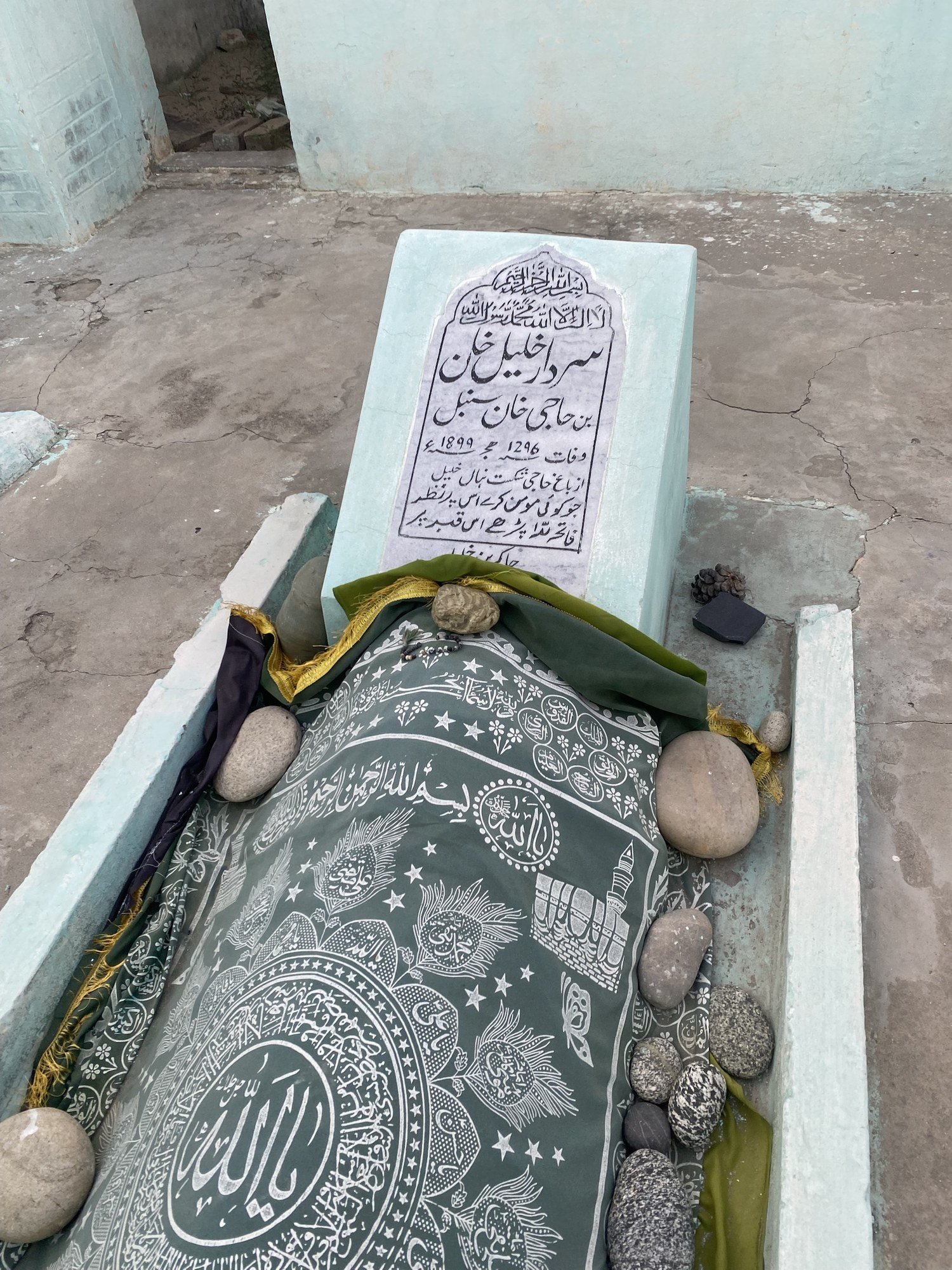
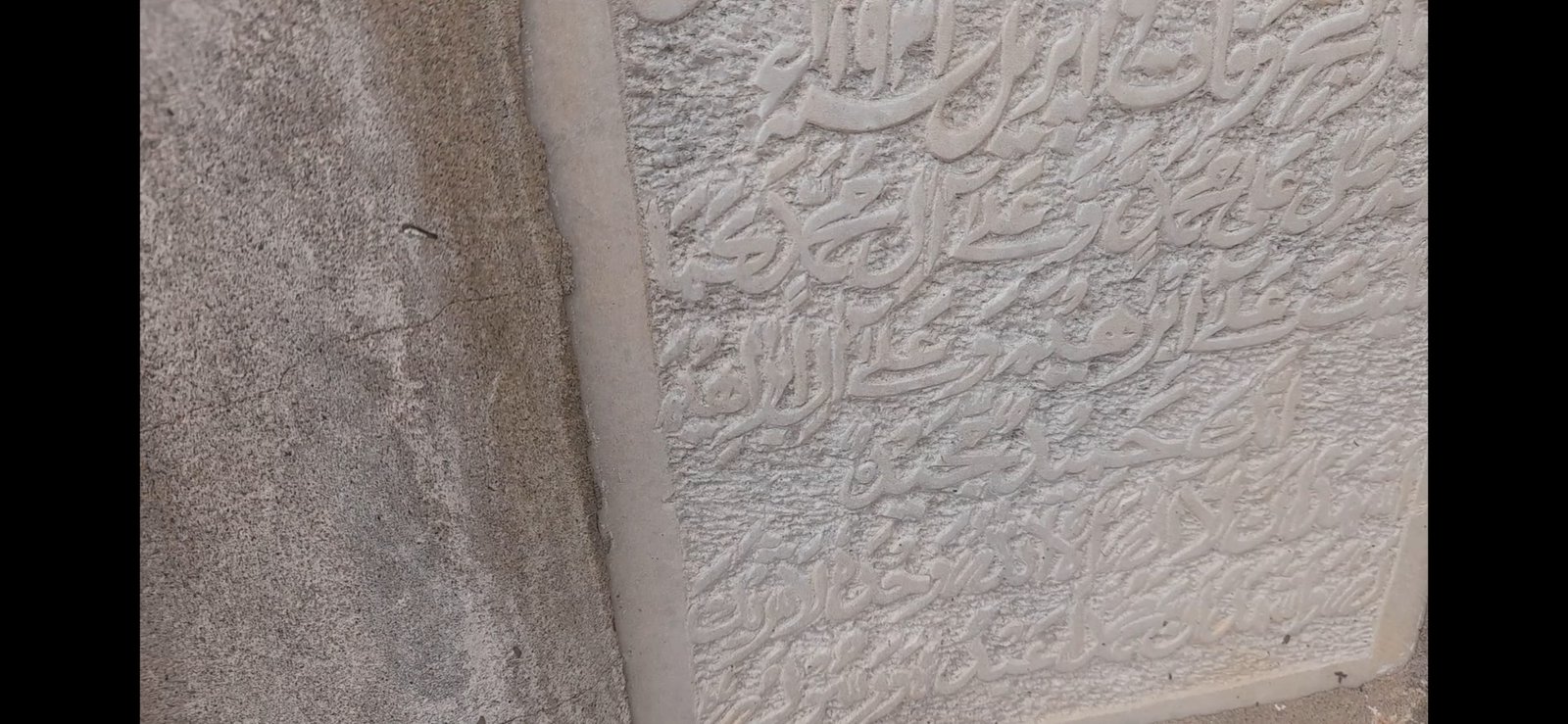
The grave of Muhammad Khalil Khan Sumbal
بسم اللہ الرحمن الرحیم لا الہ الا اللہ محمد رسول اللہ سردار خلیل خان بن حاجی خان سنبل وفات سنہ ۱۲۹۶ ہجری / سنہ ۱۸۹۹ء از باغ حاجی شکست نہالِ خلیل جو کوئی مومن کرے اس پر نظر / فاتحہ خلد پڑھے اس قبر پر
Muhammad Khalil Khan Sumbal · 1809 – 1899
Kundian graveyard, Mianwali District
The grave of Muhammad Khan Sumbal
بسم الله الرحمن الرحيم … خان محمد خان سنبل روکڑی … خان تاریخ وفات ۱۹۲۱ء
Muhammad Khan Sumbal · 1860 – 1925
Mianwali City graveyard
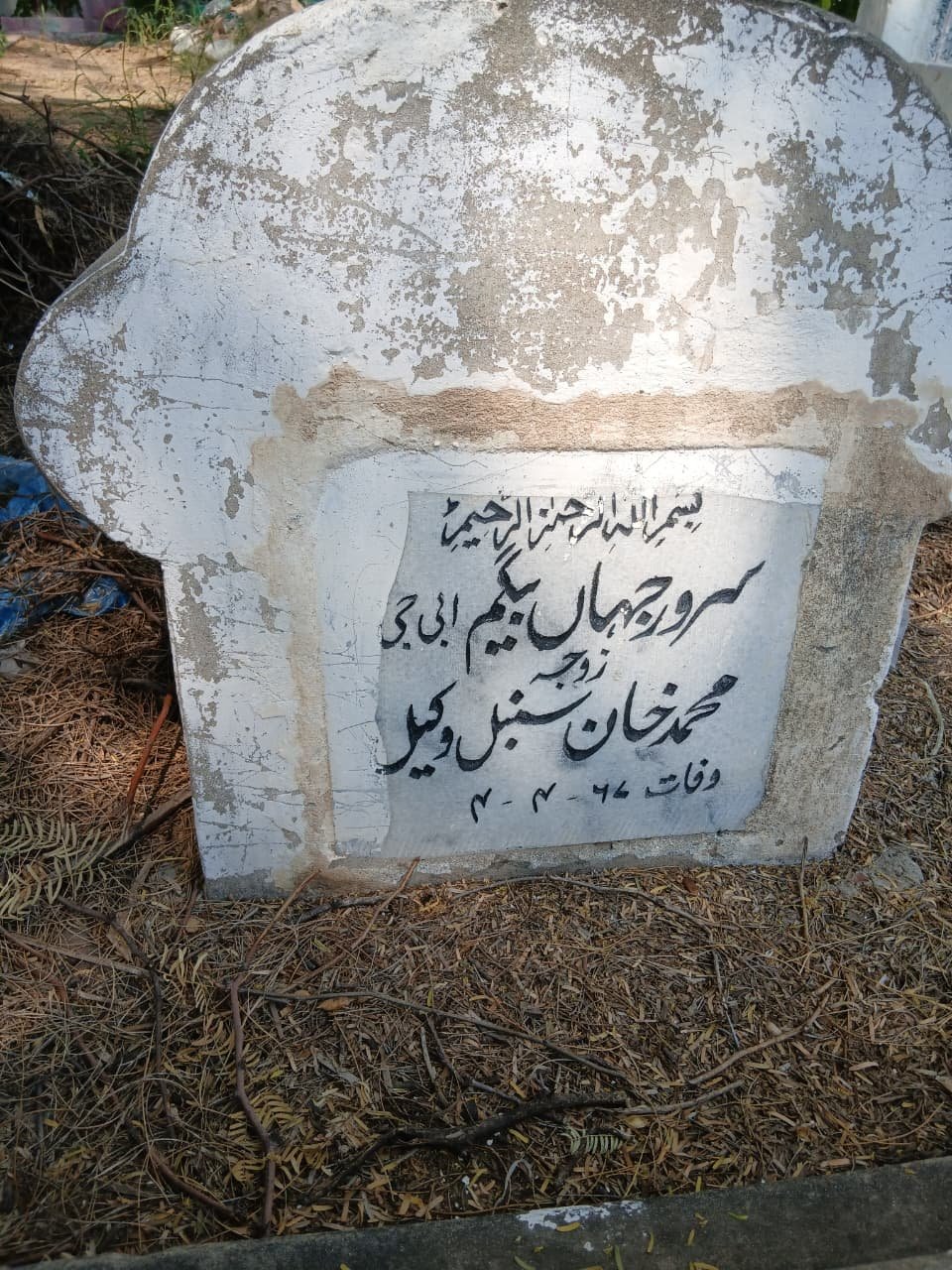
The grave of Sarwar Jahan Begum
بسم اللہ الرحمن الرحیم سرور جہاں بیگم ابی جی زوجہ محمد خان سنبل وکیل وفات ۲-۲-۲۷
Sarwar Jahan Begum · 1870 – 1927
Mianwali City graveyard
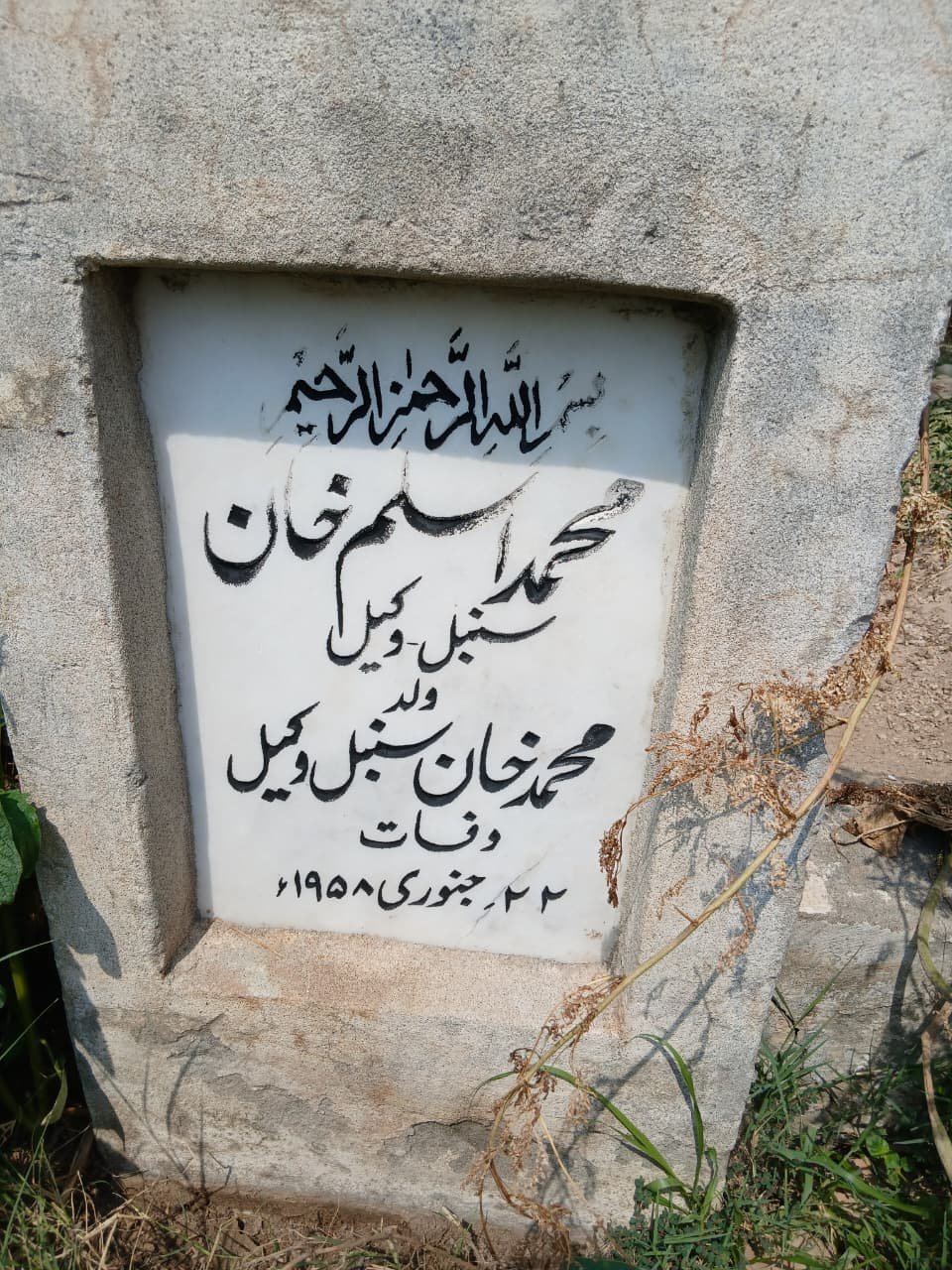
The grave of Muhammad Aslam Khan Sumbal
بسم اللہ الرحمن الرحیم محمد اسلم خان سنبل وکیل ولد محمد خان سنبل وکیل وفات ۲۲ جنوری ۱۹۵۸ء
Muhammad Aslam Khan Sumbal · 1896 – 1958
Mianwali City graveyard
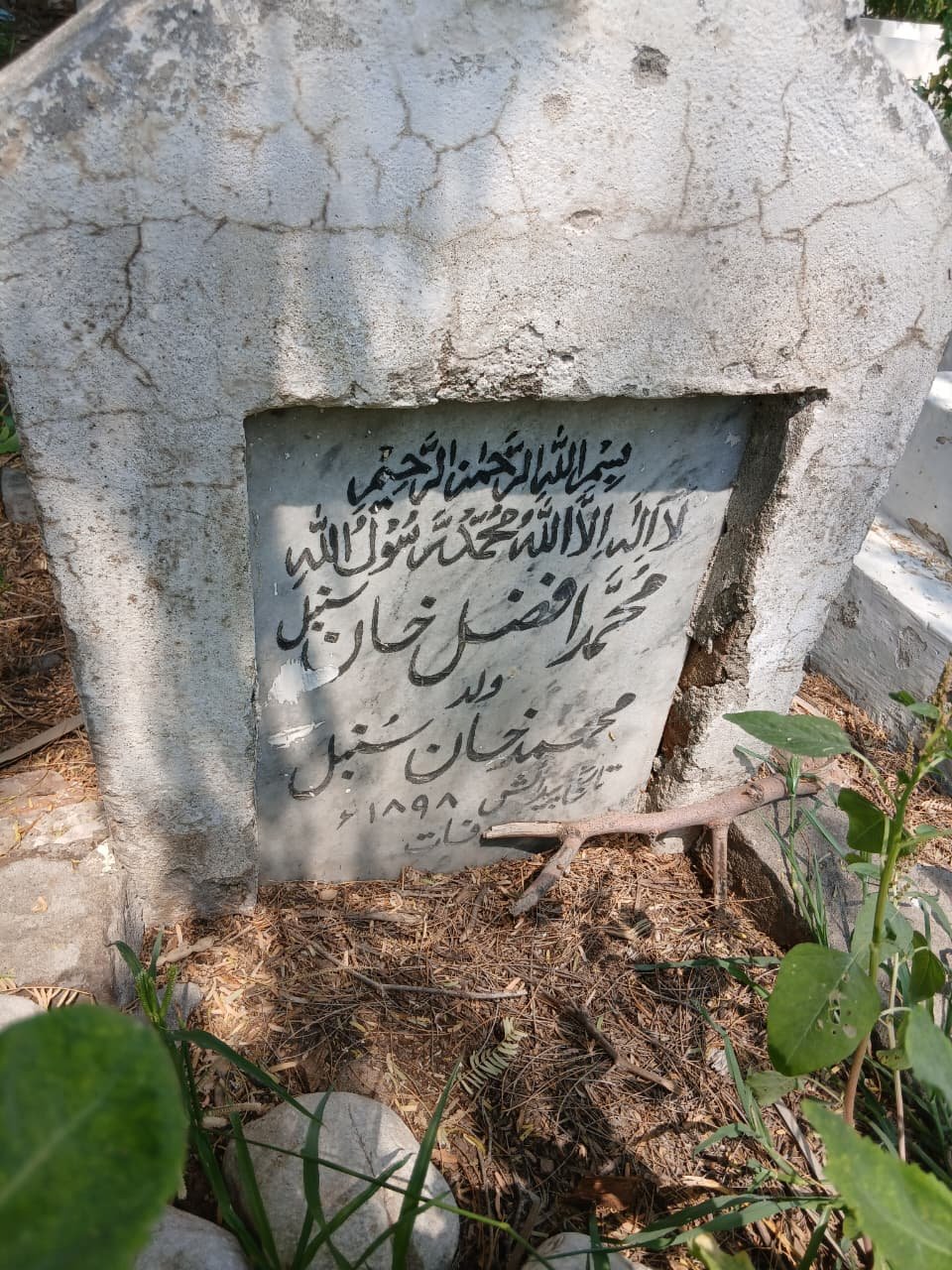
The grave of Muhammad Afzal Khan Sumbal
بسم اللہ الرحمن الرحیم لا الہ الا اللہ محمد رسول اللہ محمد افضل خان سنبل ولد محمد خان سنبل تاریخ پیدائش ۱۸۹۸ء وفات … (زیرِ زمین)
Muhammad Afzal Khan Sumbal · 1898 – ?
Mianwali City graveyard
The grave of Muhammad Ameer Khan Sumbal
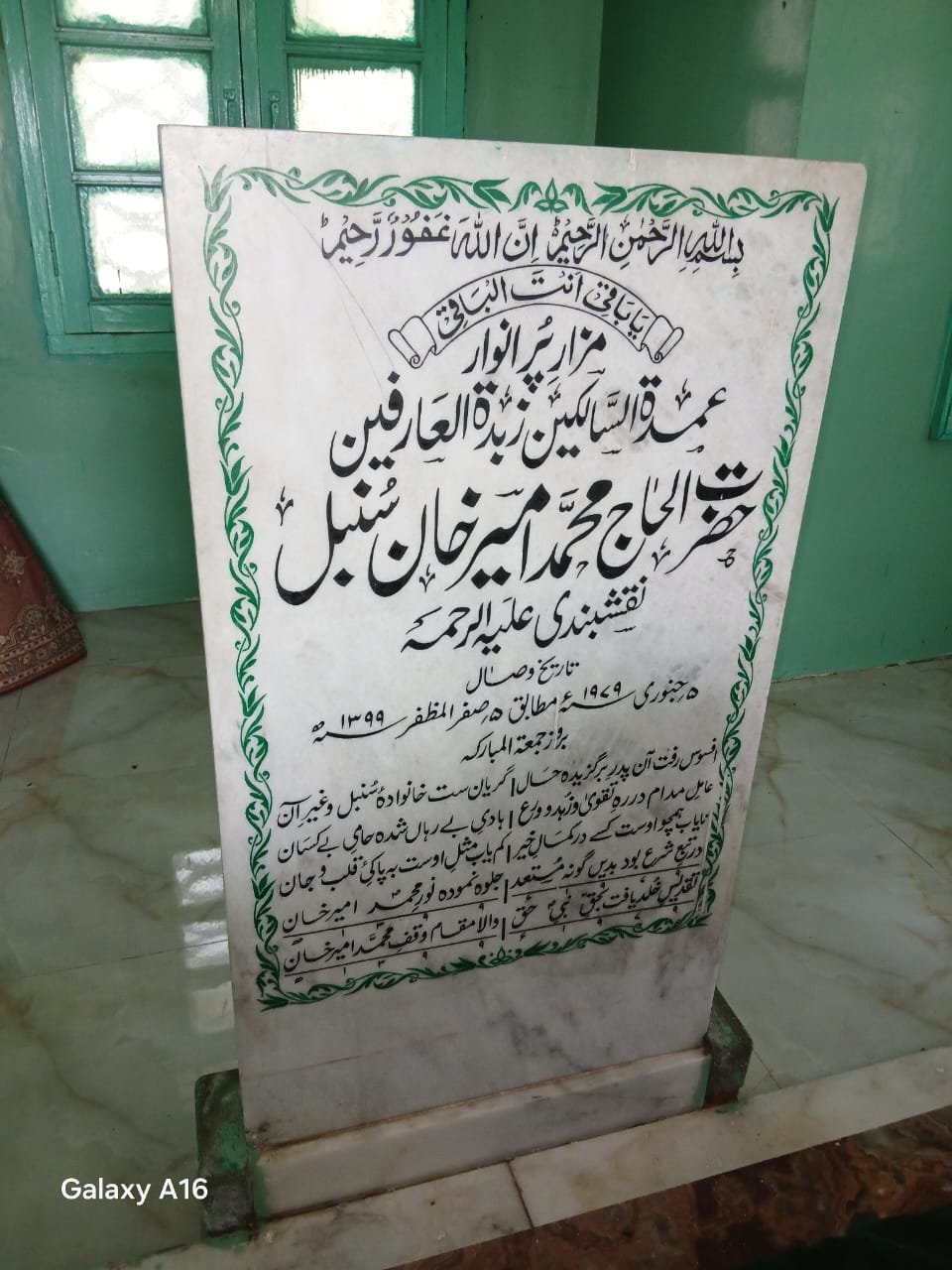
بسم اللہ الرحمن الرحیم ان اللہ غفور رحیم یا باقی انت الباقی مزار پُر انوار عمدۃ السالکین زبدۃ العارفین حضرت الحاج محمد امیر خان سنبل نقشبندی علیہ الرحمہ تاریخ وصال ۵ جنوری ۱۹۷۹ء مطابق ۵ صفر المظفر ۱۳۹۹ھ بروز جمعۃ المبارکہ
Muhammad Ameer Khan Sumbal · 1901 – 1979
Pakka Sumbalan, Mianwali

Lives

What the record says of them

Muhammad Khalil Khan Sumbal

1809 – 1899

The grave is under a roofed enclosure at Kundian. Note: 1296 AH corresponds to 1878-79 CE, not 1899, so one of the two dates on the stone is in error; the family record gives 1899.

Add what you know

Muhammad Abdullah Khan IsaKhel

1825 – 1903

The subject of the printed pedigree "Khan Abdulla, Khan Bahadur, of Isa Khel", page 282. Birth 1825 printed; death 1903 added later in pencil.

Add what you know

Sardar Ahmed Khan Sumbal

1843 – 1920 · Rissaldar and Woordie Major, 11th (Prince of Wales's Own) Bengal Lancers; Honorary Magistrate, Mianwali

Son of Sardar Khalil Khan Sumbal. Enlisted in the 11th (Prince of Wales's Own) Bengal Lancers in about 1865, aged 22, and served thirty-two years. Second Afghan War, present at the capture of Ali Masjid; the Afghan Boundary Commission, 1884

Add what you know

Muhammad Khan Sumbal

1860 – 1925 · Advocate, LLB (Aligarh)

Educated: LLB at Aligarh University, Aligarh, India.

Add what you know

Muhammad Attaullah Khan IsaKhel

1865 – ?

Birth year 1865 added in pencil to the printed pedigree, page 282.

Add what you know

Sarwar Jahan Begum

1870 – 1927

Known as Dadi Abbi. Lived at Kucha Khela.

Add what you know

Muhammad Saif Ullah Khan Isakhel

1887 – 1944 · Member, Punjab Legislative Council (Mianwali) 1921–1930

Second son of Sardar Faizullah Khan of Isakhel. Elected three times for the Mianwali Muhammadan-Rural seat and sat in all three Punjab Legislative Councils of the reformed era: 8 January 1921 to 27 October 1923, 2 January 1924 to 27 October

Add what you know

Muhammad Ahmed Ullah Khan Isakhel

1891 – ?

Given as aged 8 on the printed pedigree, page 282, compiled 1899 — so born 1891.

Add what you know

Muhammad Aslam Khan Sumbal

1896 – 1958 · Advocate

Add what you know

Muhammad Afzal Khan Sumbal

1898 – ? · Selected Head Constable but did not join, Then selected in Army later on through Bird Wood Commander in Chief, but also did not join. Self employed in the end.

Add what you know

Muhammad Atta Ullah Khan Sumbal

1908 – 1998 · Lieutenant Colonel, Pakistan Army

Title: Col.

Add what you know

Muhammad Shaukat Mehmood Khan Sumbal

1910 – 1997 · of Mianwali

A student of Camel Pur College, He was superintendent at DC office Mianwali, Selected in Army at second lt but could not join due to Health issues. He was also given a job at Radio Pakistan as pioneer but did not like the atmosphere and le

Add what you know

The family tree

The whole record is open to the family

Members see every generation drawn out, search it by name, work out how any two relatives are connected, and keep their own branch up to date. Accounts are for the family, approved one by one.

Member login Request an account

Know something the record is missing — a date, a marriage, a village, a grave, a correction? Send it to us. No account needed.